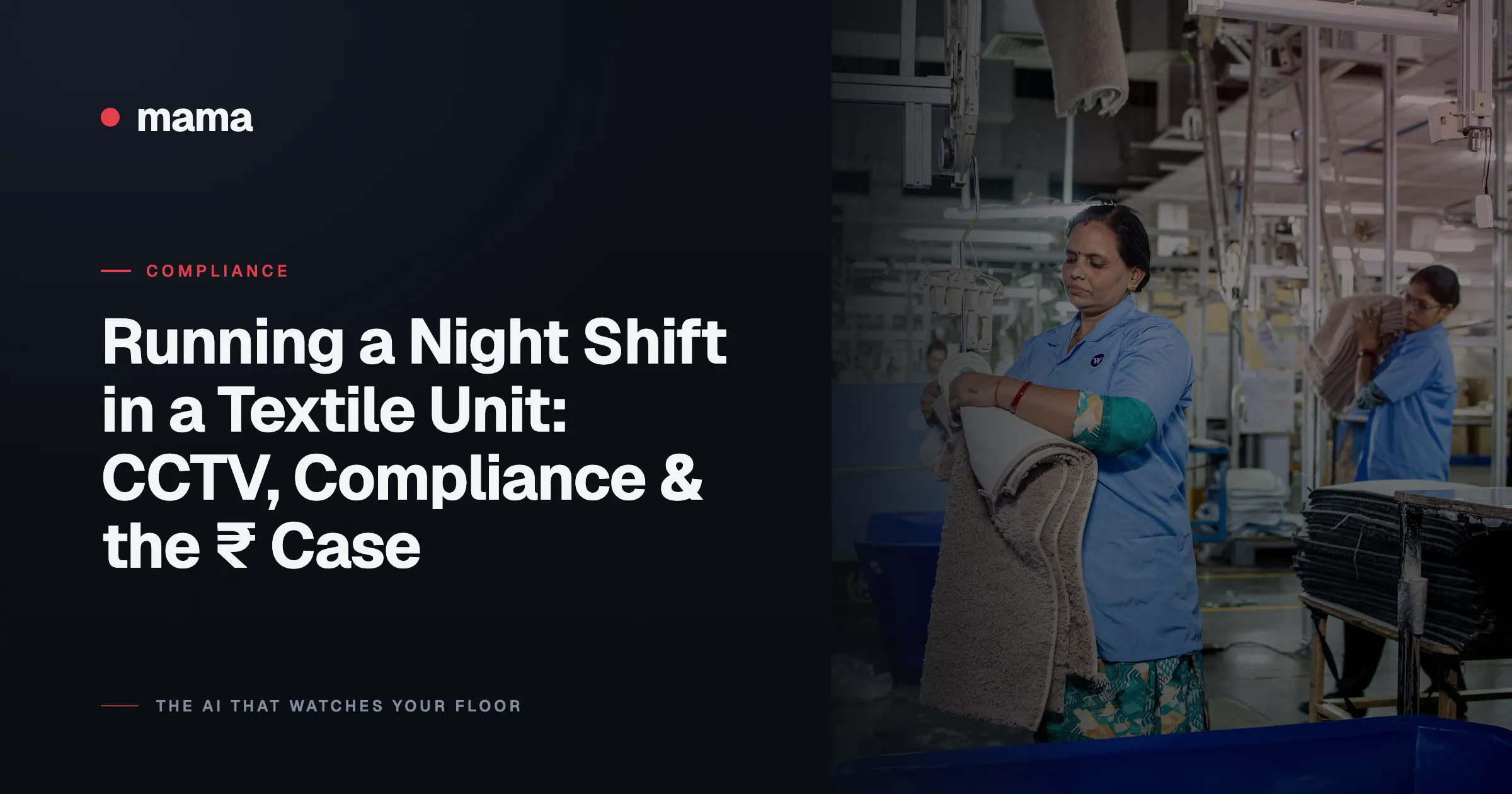
Running a Night Shift in a Textile Unit: CCTV, Compliance & the ₹ Case
A night shift is the cheapest capacity you already own — the machines are bought, the shed is built. In most Indian states you can now run women on nights, but only with safeguards, and CCTV with retained footage is usually the centre of them. Get the camera and compliance piece right and the third shift becomes export capacity, not risk.
For a Tirupur knitwear house or a Ludhiana hosiery unit, the constraint is rarely orders — it is throughput and labour. Garment lines run women-heavy, so any serious night-shift plan is, in practice, a women's night-shift plan. That is a compliance category with its own rules, and it is also what your buyers' social auditors increasingly ask to see. This guide walks the money case and the camera realities specific to textile units, so the third shift adds capacity instead of audit findings.
Rules differ by state and change often, and several 2025 amendments are recent. Treat the specifics below as a starting checklist to confirm with your labour-law advisor and the current state notification — not as legal advice.
Key points
- Night shift = capacity you've already paid for. The shed, the machines and the power connection are sunk costs. A third shift spreads them across more output — the classic argument for unlocking export volume when order books allow.
- Garment lines are women-heavy, so the relevant rule is "women on night shift." States that permit it (following the landmark 2000 Madras High Court judgment in Vasantha R and later state amendments/notifications) attach conditions: written consent, safe transport, minimum batch sizes, POSH safeguards — and CCTV.
- CCTV retention is commonly ~45 days for the women's-night-shift permission in states like Maharashtra (amended Rule 102-B) and Tamil Nadu — scoped to the night-shift safeguard, not a blanket factory-wide rule. Longer "90-day" figures you may hear are not Maharashtra's number; confirm your own state's exact wording.
- Your buyers may check this before the government does. SEDEX/SMETA and amfori BSCI social audits look at health, safety and worker-protection systems; functioning cameras, lit walkways and complaint systems are the kind of evidence that keeps a customer's compliance team comfortable.
- Textile floors break cameras in specific ways — lint, humidity, and piece-rate line layouts — so a generic CCTV quote often under-delivers exactly where you need footage most.
Why the night shift is a money door, not a cost
Tirupur alone is reported to make up more than half of India's knitwear exports, with hundreds of thousands of workers — and the cluster has lived with a structural labour shortfall, with export houses repeatedly citing a significant worker shortage in recent years. When demand is there, the binding constraint is often hours of machine time you can staff, not machines.
A third shift is the highest-leverage lever because the fixed costs are already spent. You are not buying a new shed; you are asking the one you have to work 24 hours instead of 16. For an export unit chasing a delivery window, that is the difference between accepting an order and turning it away. The compliance spend to unlock it — cameras, lighting, transport, guards — is small against the capacity it releases, which is why it is worth doing properly the first time.
(Want the number for your own unit? Our third-shift ROI calculator for textile & auto units walks the capacity-vs-cost maths line by line.)
The compliance layer: women on night shift
Because garment and hosiery lines are staffed heavily by women, the practical gate is each state's women's-night-shift regime. The recurring conditions across states look like this:
| Requirement | Typical shape (confirm per state) |
|---|---|
| Written consent | Individual consent from each woman (e.g. Form L type declarations); night work not forced |
| Minimum batch | No lone women on shift — commonly ≥2 women per night shift in factories |
| CCTV coverage | Entry/exit, walkways, amenity areas, often surrounding areas; footage retained (commonly ~45 days) |
| Lighting | Well-lit passageways, toilets, washrooms, changing rooms, entry/exit |
| Transport | Employer-arranged pickup/drop, often with a guard and camera in the vehicle; transport register |
| POSH & facilities | Functioning Internal Complaints Committee, lockable toilets/changing rooms, sometimes women security guards |
| Hours | Caps on daily/weekly hours and overtime per the state notification |
Two clarifications worth pinning down for your specific location, because owners get these wrong:
- Retention is scoped, not universal. The ~45-day figure associated with Maharashtra's amended Rule 102-B is tied to the women's-night-shift safeguard package, not a blanket rule on every factory camera. Tamil Nadu's night-shift conditions similarly reference maintaining footage for at least ~45 days. If someone quotes you "90 days," that is not Maharashtra's number — get the exact requirement for your state in writing.
- Tamil Nadu (Tirupur) vs Punjab (Ludhiana) will differ. Tirupur units fall under Tamil Nadu's rules and recent shops/establishments and factory notifications; Ludhiana units follow Punjab's. The shape rhymes, the specifics — retention days, batch numbers, transport wording — do not. There is a deeper walkthrough in our women's night-shift CCTV compliance guide for Indian factories.
The point is not fear. It is that the same cameras that satisfy the state also give you the operational visibility below — one spend, two returns.
What buyers' audits actually look for
Most Tirupur and Ludhiana exporters live inside a customer's social-compliance programme — usually SEDEX/SMETA or amfori BSCI. These audits center on labour standards and health & safety; a 2-pillar SMETA covers labour + H&S, a 4-pillar adds environment and business ethics.
Cameras are not, on their own, a certification checkbox in these schemes. But the systems they evidence are exactly what auditors probe: is the floor safe and lit, are exits clear, is there a working grievance mechanism, are women protected on shift? A night-shift operation with retained CCTV, lit amenity areas and a documented complaints process is far easier to demonstrate as compliant than one relying on verbal assurance. In practice, buyer audits often arrive before a state inspector does, so building the night shift to audit standard protects the order book directly.
Textile camera realities most guides skip
A generic security quote assumes an office corridor. A knitting hall, a dyeing house and a stitching floor are harsher, and each defeats cameras differently. Plan for the environment, not just the pixel count:
| Textile floor reality | What it does to cameras | Practical response |
|---|---|---|
| Lint & cotton fluff (knitting, stitching) | Coats lenses and housings within weeks → blurred, useless footage; clogs fan-cooled housings | Sealed housings, lenses you can wipe on a cleaning round, placement out of direct fly-off zones |
| Dyeing-house heat & humidity, chemical vapour | Condensation, fogging, corrosion of cheap housings | IP-rated/weatherized housings rated for the zone; don't reuse the same spec as the dry stitching hall |
| Piece-rate line layout | Long parallel lines, operators packed close; a single dome misses most bundles | Line-length coverage and angles that see the bundle flow, not just the aisle |
| Fabric & bundle theft | High-value fabric and finished pieces move at shift-change and gates | Gate, cutting-room and dispatch coverage with retained footage; shrinkage is a real ROI line, not just compliance |
| Low night lighting to "save power" | Grainy, unusable night footage — fails both audit and investigation | Low-lux/IR cameras plus the lit walkways the rule requires anyway |
There is a cluster-specific breakdown — including where to place cameras across cutting, knitting, stitching and dispatch — in our textile factory camera guide for the Tirupur cluster.
Beyond compliance and theft, the same footage answers the questions that actually move margin on a piece-rate floor: which lines lost time last night, where bundles piled up, whether the third shift held the same output as the first. That operational read is where cameras stop being a cost line and start paying rent — the core of what Mama is built to do for an owner who can't be on the floor at 2 a.m.
FAQ
Is it legal to run women on the night shift in a textile unit? In many states, yes — following the 2000 Madras High Court judgment (Vasantha R) and subsequent state amendments/notifications — but only with the safeguard package (consent, transport, batch sizes, CCTV, POSH). Whether and how depends on your state's current notification. Confirm with a labour-law advisor before scheduling.
How long must I keep CCTV footage? For the women's-night-shift permission, ~45 days is a common figure (e.g. Maharashtra's amended Rule 102-B, and Tamil Nadu's conditions). This is scoped to the night-shift safeguard, not necessarily every camera in the plant. Longer periods you may hear quoted are not Maharashtra's number — verify your state's exact wording.
Do SEDEX or BSCI audits require CCTV specifically? Not as a named line item. They assess labour standards and health & safety systems; retained CCTV, lit areas and a working complaints process are strong evidence that those systems function, which is what auditors want to see.
Will lint really ruin my cameras? On knitting and stitching floors, uncovered lenses can blur within weeks. Sealed housings, sensible placement and a wipe on the cleaning round keep footage usable — plan for it up front rather than after the first failed audit.
What's the fastest way to size the payback? Start from spare machine-hours and the labour you can staff, net of the compliance spend. Our guard/third-shift ROI tool gives a first-pass number in a couple of minutes.
JSON-LD note: publish with Article schema plus a FAQPage block built from the five FAQ Q&As above (each as a Question / acceptedAnswer pair). Set about to "textile factory night shift CCTV compliance India" and link sameAs/citation to the state notifications and SMETA/BSCI references once expert sign-off confirms the exact rule citations.
Compliance details (retention days, batch sizes, transport wording) vary by state and were amended as recently as 2025; figures here are indicative and pending expert sign-off. Confirm against the current Tamil Nadu / Punjab / Maharashtra notifications before acting.